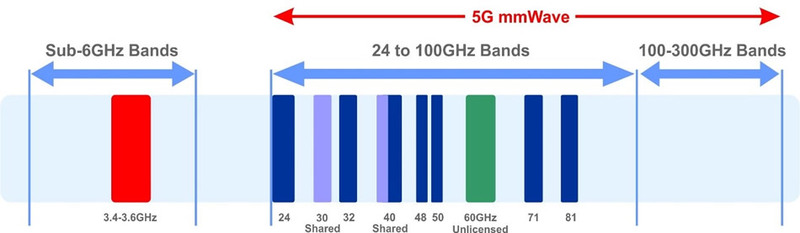
Ultimate Guide for 5G mmWave Bands [FR2]Before talking about the challenges of 5G Network planning and optimization in the mmWave band, let’s start with the common question, Why we need mmWave especially for 5G technology? History of High Frequencies in Mobile Communication While high frequencies have been used for point-to-point network backhaul links, cellular carriers have never before made What are the mmWave Bands? Millimeter-wave spectrum is the band of spectrum between 30 GHz and 300 GHz. Wedged between microwave and infrared waves, this spectrum can be used for high-speed wireless communications as seen with the latest 802.11ad Wi-Fi standard (operating at 60 GHz). The high-frequency bands in the spectrum above 24 GHz were targeted as having the potential to support large bandwidths and high data rates, ideal for increasing the capacity of wireless networks. These high-frequency bands are often referred to as “mmWave” due to the short wavelengths that can be measured in millimeters. Although the mmWave bands extend all the way up 300 GHz, it is the bands from 24 GHz up to 100 GHz that are expected to be used for 5G. The mmWave bands up to 100 GHz are capable of supporting bandwidths up to 2 GHz, without the need to aggregate bands together for higher data throughput.
mmWave makes possible blazing 5G speeds that simply can’t be achieved in the single channels available at lower frequencies, but that performance comes with a hefty price in propagation.
The Wavelength of mmWave Bands High frequency means narrow wavelengths, and for mm waves that sits in the range of 1 millimeter to 10 millimeters. Its strength can be reduced due to vulnerabilities against gases, rain, and humidity absorption. And to make matters even less appealing, due to those factors millimeter wavelengths only reach out to a few kilometers.
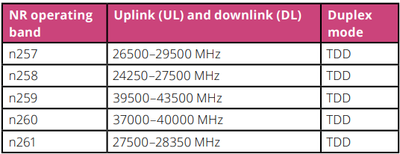
The actual wavelengths of most of those “millimeter wave” frequencies are closer to a centimeter: the full wavelength size for mmWave wavelengths Cellular low-band wavelengths As the spectrum goes, the higher the frequency, the greater the path loss, and therefore, the shorter the range of each 5G mmWave Frequency Bands At WRC-2019 in November, several new frequency ranges were identified for IMT, to be used by IMT-2020 (5G). These encompassed many of the existing 3GPP-bands plus some new spectrum ranges:
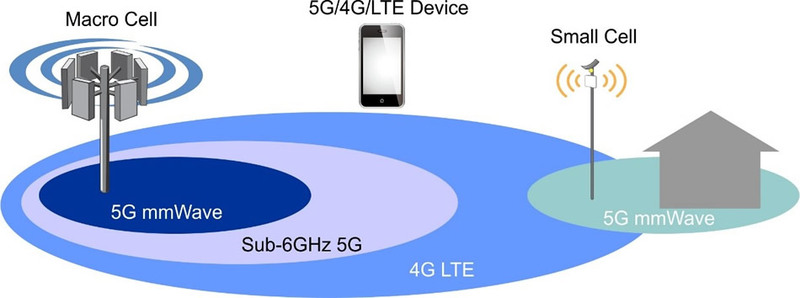
The Challenges of 5G mmWave Deployment The high penetration losses and blocking mean that mmWave deployments will cover outdoor or indoor environments, but not provide outdoor to indoor connectivity. The mmWave cell sizes will, therefore, be smaller and higher in density. Also, it can be expected that mmWave will coexist in tight integration with 5G deployments below 6 GHz as well as 4G LTE. Short transmission paths and high propagation losses allow for spectrum reuse by limiting the amount of interference between adjacent cells. In addition, where longer paths are desired, the extremely short wavelengths of mm-wave signals make it feasible for very small antennas to concentrate signals into highly focused beams with enough gain to overcome propagation losses. The short wavelengths of mmWave signals also make it possible to build multi-element, dynamic beamforming antennas that will be small enough to fit into handsets.
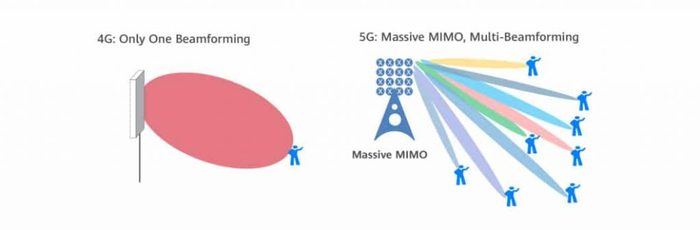
The Solution! To compensate for higher path loss and shorter range, 5G systems are making use of beamforming and beam steering with complex antenna arrays that direct high gain beams toward user devices, either in a static grid or with more sophisticated tracking of devices.
5G device support for bands above 24 GHz 5G device support for spectrum bands above 24 GHz is still at an early stage. GSA’s GAMBoD database includes 84 announced
Possible 5G mmWave Deployment Scenarios The International Telecommunication Union (ITU) identified three main categories for the 5G NR architecture; Enhanced Mobile Broadband (eMBB) for greater mobile capacity, Ultra-reliable and Low-latency Communications (uRLLC) for mission-critical services, and Massive Machine Type Communications (mMTC) for vast numbers of low-cost, low-energy devices (Internet of Things). These broad areas provide plenty of early deployment possibilities for 5G mmWave, such as the following:
Resources
Ask Moniem
mmWave Youtube Videos |